Love Language Test — find your love language in 30 quick choices
If a hug at the door means more to you than flowers, or the other way round, the love language test below shows how much more, across all five languages, in 30 quick this-or-that choices. Free, no email, and nothing leaves your browser.
Love language test
What makes you feel most loved?
Tap the option that would mean more to you — go with your first instinct. 30 quick choices, about 5 minutes.
- Pick one of two moments, 30 times.
- See your five scores as envelopes.
- Compare result codes with your partner.
No email, no sign-up. Your answers stay in this browser.
Question 1 of 30
How I show love
Which would mean more to you?
Your main love language
Your five scores
Points out of 12 per language — each one appears in 12 of the 30 choices. Percentages are rounded, so they may not add up to exactly 100.
Next: ask your partner to take the test too, then compare your result codes below.
Our own self-reflection quiz inspired by Gary Chapman's five love languages — not the official assessment and not a clinical test.
What Words of Affirmation means
Ideas for this week
Try them with someone whose language this is — or share the list with the people close to you.
Your result code
Saved in this browser only.
Give vs receive
10 more choices about how you usually show love — then see giving and receiving side by side.
How you like to receive
How you show love
Ranked vs rated
Forget the pairs for a moment: how important is each one to you? 0 = hardly matters, 10 = essential.
Ranked in the test Rated 0–10
Compare with a partner
Send them your code. Once they have taken the test on their own device, paste their code here — nothing is uploaded.
You
Partner
The five love languages at a glance
Gary Chapman's idea is simple: people feel loved through different kinds of gestures, and the one you value most is not always the one your partner thinks to give. What stings when a language goes missing is often the quickest way to recognise your own.
| Love language | Day to day | A small example | What stings when it's missing |
|---|---|---|---|
| Words of Affirmation | Appreciation said out loud or written down | "I saw how patient you were with your dad today." | Effort nobody mentions; criticism that lands hard |
| Quality Time | Undivided attention, phones away | A walk after dinner with no screens | Half-listening, cancelled plans |
| Receiving Gifts | Small things that prove you were thought of; price hardly matters | Your favourite snack, picked up on the way home | A forgotten birthday, a generic present |
| Acts of Service | Practical help that takes something off your plate | They deal with the insurance renewal you'd been dreading | Broken promises, being left to do everything |
| Physical Touch | Hugs, a hand on the back, sitting close | Holding hands on the walk home | A hug held back after an argument |
Most people nod at all five rows. That's why the love language test below doesn't ask whether you like each one: it asks which you'd pick when you can only have one of two.
How this love language test works
You get 30 cards, each a small situation (a hard week, a birthday, a long car journey) with two responses from different love languages. Tap the one that would mean more to you and the next card appears. "Question 7 of 30" and the heart bar show your progress; Back and Restart do what they say; on a keyboard, ← or A picks the left option, → or B the right one, and Backspace goes back. It takes about five minutes.
The bank is balanced on purpose. Five languages make ten pairings, and each pairing appears exactly three times, so every language sits on 12 cards, six on the left and six on the right. No language gets more chances to score, and a retake reshuffles order and sides. If a quiz pits gifts against touch more often than words against time, part of your profile comes from the quiz, not from you.
The five love languages are Gary Chapman's concept, from his book The 5 Love Languages. Ours is an independent test inspired by it, with scenarios written for this site. It is not the official assessment and is not affiliated with Chapman or his publisher. For the original, take the official Love Language quiz; if both put the same two languages on top, trust that pattern more.
Reading your result: main language, second, ties and close calls
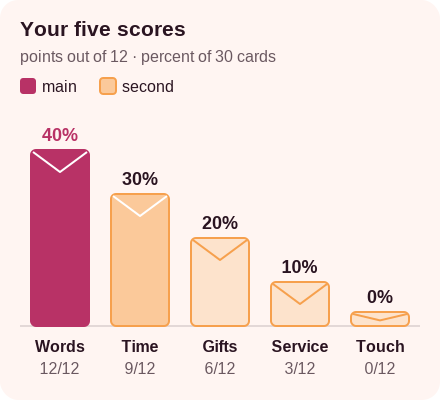
Each point is one card where you chose that language, so scores run from 0 to 12 and always add up to 30. "Your five scores" shows them as envelopes, each with its percentage and a label like "12 of 12". Percentages are rounded, so the five may total 99 or 101.
"Your main love language" is the top score and "Second" the next. "It's a tie" means the top is shared; the test won't pick a winner for you, so there is no Second line. "Close call" means a 1-point lead, one card out of 30. My rule of thumb: 1 point means both languages are yours, 2 to 3 is a lean, 4 or more a clear preference. A 0 doesn't mean that language leaves you cold, only that something else always won.
Worked examples
A clear profile: Words of Affirmation first
You always pick Words of Affirmation, then Quality Time over the rest, then Receiving Gifts, then Acts of Service; Physical Touch never wins. Points: 12, 9, 6, 3, 0.
The rest give 20 %, 10 % and 0 %. Main: Words of Affirmation; Second: Quality Time; gap 3 points, so no close call. Result code LL1-c9630, where "c" stands for 12.
A close call: Quality Time just ahead of Physical Touch
Points: Words 6, Time 8, Gifts 4, Service 5, Touch 7.
The others round to 20 %, 13 % and 17 %. Time leads by 8 − 7 = 1 point: "Close call". Read it as a pair: a walk holding hands will land better than a present or a tidy kitchen.
Two partners: does one person's giving fit the other's wishes?
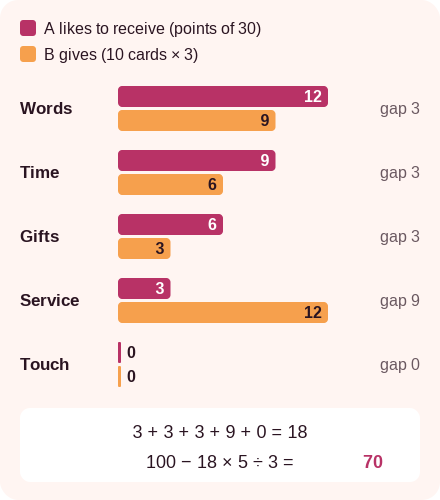
Partner A has the first profile (12, 9, 6, 3, 0). Partner B did the 10-card giving round: 3, 2, 1, 4, 0. Multiplied by 3 to match 30 cards: 9, 6, 3, 12, 0.
Match score = 100 − 18 × 5 ÷ 3 = 70
Half the gap is one language: Acts of Service takes 40 % of B's giving, but A picks it only 10 % of the time. B's effort is real; moving some of it from chores to kind words would land better.
The arithmetic behind the envelopes
- Percent: points ÷ 30 × 100, rounded to a whole number (halves up).
- Giving round: 10 cards, each pairing once; 0 to 4 points; percent = points × 10.
- Result code: LL1- plus the five receiving scores as single characters (a = 10, b = 11, c = 12), then a dash and the five giving scores if you did that round.
- Match score: multiply one partner's giving points by 3, add up the differences from the other's receiving points, and take 100 − 5 ÷ 3 × that sum. If both codes carry giving scores, you get two match scores, one for each direction. If neither does, the two receiving profiles are compared instead: "How alike your love languages are".
Why 5 ÷ 3? Two 30-point profiles can differ by at most 60, so the score is 100 × (1 − difference ÷ 60): identical profiles score 100, opposite ones 0. Summing differences follows the mismatch measure of Mostova, Stolarski and Matthews, who summed over 20 rating items; we use the five scores. The tool is tested against these cases:
| Answers | Points | Expected |
|---|---|---|
| Always Words > Time > Gifts > Service > Touch | 12 · 9 · 6 · 3 · 0 | 40/30/20/10/0 %; LL1-c9630 |
| Always Touch > Service > Gifts > Time > Words | 0 · 3 · 6 · 9 · 12 | main Physical Touch, second Acts of Service; LL1-0369c |
| Circular: each beats two, loses to two | 6 · 6 · 6 · 6 · 6 | 20 % each; five-way tie |
| Time > Touch > Words > Service > Gifts, reversed on every third card of a pairing | 6 · 8 · 4 · 5 · 7 | main Quality Time, close call; LL1-68457 |
| Words and Touch tied on top | 10 · 3 · 0 · 7 · 10 | 33/10/0/23/33 % (sum 99); tie, no second; LL1-a307a |
| Giving: Service > Words > Time > Gifts > Touch | 3 · 2 · 1 · 4 · 0 | main Acts of Service, close call; LL1-c9630-32140 |
| First row receiving, fourth row giving | gaps total 18 | Match score 70 |
| Both gave: LL1-c9630-32140 and LL1-0369c-32140 | gaps total 18 and 30 | Match scores 70 and 50 |
| No giving round: LL1-c9630 and LL1-0369c | gaps total 36 | How alike: 40 |
Giving vs receiving, and comparing with a partner
What you give can differ from what you want: plenty of people who melt at a kind word show love by fixing things. "Add how I show love" runs 10 more cards and opens "Give vs receive"; if one language takes at least 20 percentage points more of your giving than of your receiving, it tells you so. "Rate each one separately" adds five 0–10 sliders next to your ranking in "Ranked vs rated", because in real life nobody makes you choose between a hug and a kind word.
To compare, press "Copy my result code" and send it. "Invite your partner" does the same in one step: the link carries your code, so the comparison is ready the moment they finish. Your partner takes the test, pastes it into "Partner's result code" and presses "Compare" to see the "Match score". Nothing goes to a server; your last result stays in your browser until "Forget saved result". The "Read about" chips switch the description and "Ideas for this week" to any of the five languages, and "Copy summary" and "Print" turn the result into something to act on.
What the research says
A review of 10 studies by Emily Impett, Gideon Park and Amy Muise found no support for three core assumptions: one primary love language per person, exactly five languages, and happier couples when languages match (University of Toronto summary). Forced choice creates trade-offs real life doesn't, and they suggest a balanced diet: keep every kind of care on the menu. In a study of 100 couples, Mostova and colleagues found that when one partner's way of showing love fitted what the other liked to receive, both reported higher satisfaction. It's a correlation, not proof, but it's why I'd look at the giving round before the top label.
Use the result to start a conversation, not to end one. "That's not my love language" is never a reason to skip the other four.
Read next: are love languages real?, how to figure out your partner's love language and can your love language change?
Guides
 Are love languages real? What relationship research actually foundOne primary language, exactly five, couples must match: what a review of 10 studies found, and where matching does seem to matter.6-minute read
 How to figure out your partner's love language without a quizWatch how they give, decode their complaints, run a one-week experiment and ask better questions, then compare result codes if they're game.6-minute read
 Can your love language change? Life stages, stress, give vs receiveA new baby, long distance, a crunch at work: how needs shift, why giving and receiving differ, and a simple check-in routine.5-minute read
Things people ask
Is this the official love language quiz?
No. It is an independent test inspired by Gary Chapman's five love languages, with scenarios written for this site, and it is not affiliated with Chapman or his publisher. The official Love Language quiz is on 5lovelanguages.com.
Can I have two love languages?
Yes. If two languages share the top score the result says "It's a tie", and a 1-point lead is marked "Close call". When people rate each language separately, most rate several of them as important.
Is my answer stored anywhere?
Only in your own browser, so the page can show your last result when you come back. Nothing is sent to a server, the result code contains only your scores, and "Forget saved result" deletes it.
What is the most common love language?
There is no reliable answer. Figures you see online come from the quiz takers of a particular site, not from a representative sample of people, so we don't quote any.
Does it work for friends and family?
Yes. Most cards describe a partner, but you can answer with any close person in mind; the five ways of showing care apply to friendships and family too.
How long does the test take?
About five minutes for the 30 main cards. The optional giving round adds 10 more cards, and rating each language separately takes a few seconds.
Updated