Are love languages real? What relationship research actually found
Partly. The five love languages describe real ways people show care, and almost everyone recognises themselves somewhere in the list. The bolder claims built on top of them (one primary love language per person, exactly five of them, couples who must match) have not held up when relationship scientists put them to the test.
That doesn't make the idea useless. It means you should know which parts stand on evidence and which are a counsellor's rule of thumb before you read too much into a quiz result, including the one on this site.
Where the idea came from
Gary Chapman developed the five love languages from patterns he noticed in the couples he counselled. His book The 5 Love Languages turned those patterns into a vocabulary that is now everywhere, from marriage courses to dating-app profiles: Words of Affirmation, Quality Time, Receiving Gifts, Acts of Service and Physical Touch.
There is nothing wrong with ideas that start in a counselling room; plenty of useful ones do. But a pattern seen across clients is a hypothesis. It becomes knowledge once someone measures it in people who weren't selected for having relationship trouble. And as the researchers below note, the couples behind the original model were mostly white, religious and in traditional mixed-gender relationships, which is a narrow base for a model meant to fit everyone.
The claims that were put to the test
Psychologists Emily Impett, Gideon Park and Amy Muise reviewed 10 studies on love languages in the journal Current Directions in Psychological Science. According to the University of Toronto summary of the review, none of the 10 studies supported Chapman's core claims. Here is how I'd sum up each claim, and what I think you can usefully do with the answer.
| Claim | What research found | What to do with it |
|---|---|---|
| Everyone has one primary love language | Not supported. When people rate each kind of expression on its own, they rate all of them as important | Read your top two or three, not just the winner |
| There are exactly five | Evidence inconsistent; other research describes further ways people express and receive love | Treat the five as a useful menu, not a complete list |
| Couples who share a love language are happier | No support for this matching effect in the studies reviewed | Don't worry if your top languages differ |
| Getting love the way you like to receive it goes with higher satisfaction | Supported as a correlation in a study of 100 couples (Mostova and colleagues) | Notice how your partner gives, and say plainly what lands with you |
| A forced-choice quiz reveals your type | Forced choice and separate ratings produce different rankings | Look at both views when you can |
Where matching does seem to matter
The fourth row needs a closer look, because it sounds like it contradicts the third. It doesn't: the two rows answer different questions.
Impett's team asked whether two people with the same love language do better together. They don't, as far as the evidence goes. Mostova, Stolarski and Matthews asked something else: does one partner's way of expressing love fit what the other prefers to receive? They studied 100 heterosexual couples. Each person filled in a rating scale twice, once for how they show love and once for what makes them feel loved. For each item they took the gap between one partner's preference and the other's behaviour and added the gaps up into a single mismatch score.
The bigger the mismatch, the lower both relationship and sexual satisfaction, for men and for women. A partner's mismatch also predicted the other person's satisfaction. And mismatch was not linked to how long couples had been together. Time alone didn't make partners better at giving each other what they wanted.
The limits matter. The study is correlational, so it can't tell whether a good fit makes people happier or whether happy couples simply show more affection of every kind. It relied on self-reports from an online sample, and the mismatch score was only moderately reliable. Still, it fits everyday experience: two people can have completely different top languages and do fine, as long as each learns to give some of what the other wants.
Why the question format changes the answer
Most love language quizzes, including the official one and the main part of ours, use forced choice: two options, pick one. That format always produces a winner, because something has to come first. It can't tell the difference between someone who loves all five and someone who only cares about one.
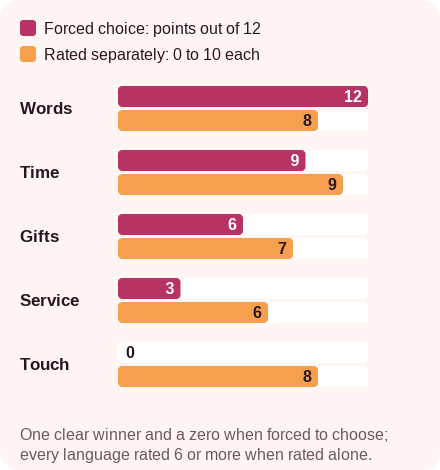
Rating each language on its own scale avoids that, which is why researchers prefer it; in the Mostova study the forced-choice question and the ratings didn't agree on the rankings. That's why our test does both. The 30 cards give you a ranking, and "Rate each one separately" adds five 0–10 sliders, shown next to the ranking in "Ranked vs rated". If four or five of your ratings are 7 or higher, you're in good company. The forced-choice winner is your tie-breaker, not your only need.
The balanced diet reading
Impett's team suggests a different picture: a relationship as a balanced diet that needs a full range of nutrients, including companionship and emotional support. The five love languages are good items on that menu. They aren't the whole menu: the review mentions supporting a partner's personal goals as something couples with more equal roles may value and the original model leaves out.
I find this the most useful way to hold the idea. Preferences are real. Some people truly feel more loved by a hand on the shoulder than by any present. But a preference is seasoning, not the meal. Someone whose top language is Quality Time still needs the bills paid and a kind word now and then.
How I'd use a love language result
- As a conversation opener. "I came out high on Acts of Service, does that sound right to you?" is a far better talk than "what's your love language?"
- Top two, not top one. If the gap between first and second is 1 point, the test marks it "Close call" for a reason.
- Look at giving as well as receiving. The part with research behind it is the fit between what one partner gives and what the other wants, so do the "Add how I show love" round and compare codes.
- Never as an excuse. "That's not my love language" is not a reason to skip a birthday or never say thank you.
- Not as a score of the relationship. The result says nothing about how much you are loved. If the same conflict keeps coming back, a couples counsellor will do more than any label.
If you're curious how a different set of questions ranks you, take the official Love Language quiz as well as our independent love language test. If both put the same two languages on top, that pattern is worth trusting. If they disagree, your top languages are probably close, and that's useful to know too.
Things people ask
Is the love language theory scientifically proven?
No. A review of 10 studies found no support for its core claims of one primary language, exactly five languages and happier couples when languages match. The ways of showing love it describes are real, though.
Why do love language results feel so accurate?
Because almost everyone values all five, any of them can feel true when you read about it. Forced choice then turns those small preferences into a clear winner.
Is it still worth taking a love language test?
Yes, as a way to start a conversation and to notice how you and your partner give and receive care. Just read the top two or three, not a single label.
Who created the five love languages?
Gary Chapman, a marriage counsellor, in his book The 5 Love Languages. The test on this site is independent and only inspired by his concept.